
Infrastructure
Mycelium
Discover, connect and manage your machines. Keep authority with your systems.
MIT OR Apache-2.0
Explore Mycelium on GitHub Future PresentLabs
Our open-source mission
AI has changed what it means to build software. We believe the old bargain—pay for access to code you cannot understand, change or own—is becoming obsolete.
Explore our GitHub ↗Open foundations & the wider ecosystem
Independently usable foundations. Optional managed operation.
Infrastructure
Discover, connect and manage your machines. Keep authority with your systems.
MIT OR Apache-2.0
Explore Mycelium on GitHub
Operating system
A small Linux system for connected machines.
First-party code: MIT OR Apache-2.0
Visit the fungOS website
Inference
A modular engine for running intelligence on infrastructure you control.
Apache-2.0
Read about UMIE
Spatial interface
Bring your connected-machine workspace into VR.
AGPLv3 · see repository terms
Explore Holodeck on GitHub
Capability fabric
Granted transport connecting applications, devices and surfaces.
MIT OR Apache-2.0
Read about UnibusEach project has its own release status and license. Managed services do not replace the public license.
Before there was a cloud, there were people sharing tools. A compiler. A kernel. A library that solved one difficult problem well. Someone wrote it, someone improved it, and someone else built something neither of them had imagined.
That is still how the world works. Beneath the polished interfaces and billion-dollar platforms are shared foundations—and the people who keep them standing. Open source is not a footnote to modern technology. It is where much of its possibility begins.
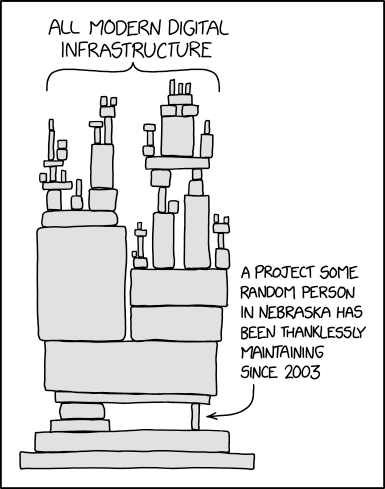
AI makes it easier to write software. It does not make the work of maintaining, understanding and trusting it disappear. We want to use that new capacity to strengthen the commons, not build another wall around it.
We open source the work we believe will provide value to our customers and users. Our ambition is a shared foundation that anyone can inspect, improve and build on—from independent developers to teams operating their own infrastructure.
That is why governance belongs in the open core. Policy, grants, distribution, node metrics and audit interfaces should not require a subscription. Your ability to operate a system should not disappear when you stop paying us.
Build with us
Our contribution is the engineering behind independently usable tools: infrastructure, inference, protocols and the connections between them.
Help make them better with a reproducible bug report, a test, clearer documentation, a driver or an integration. Share what breaks, what works and what your users need.
Find projects and contribution guides →Mycelium’s open foundation for discovery and fleet operations.
Explore Mycelium →UMIE, Unibus and the wider connected-machine ecosystem.
Meet the projects →Start with the repository’s README, license and contribution policy. Check whether a CLA is required before submitting.
Find your starting point →Permissive licenses let people use, modify and redistribute software, including within commercial and proprietary products, subject to their terms. MIT keeps the requirements simple; Apache 2.0 also provides an explicit contributor patent grant and additional notice requirements.
Mycelium declares MIT OR Apache-2.0. UMIE declares Apache-2.0. The applicable repository and release remain the source of truth.
MIT license · Apache 2.0 license
For some products, we choose strong copyleft. AGPLv3 protects the shared foundation by requiring corresponding source under its terms when covered software is distributed, and by requiring operators of modified versions to offer corresponding source to users interacting with them over a network.
It permits commercial use. It does not mean every service next to it must become open source; obligations depend on how the covered work is modified, combined and offered. Legion-of-BOM uses AGPL-3.0-or-later.
Good tools outlive their first authors. They move between teams, grow in unexpected directions and become foundations for work no one could have planned. We want the things we build together to have that kind of future.
Where a project uses a Contributor License Agreement, it makes the rights to a contribution explicit—including alternative licensing where the agreement provides for it. The public license remains your license to use the project. A CLA is not a subscription or a paywall.
Each repository publishes its own license and contribution policy. The terms should be clear before you contribute, and the shared foundation should remain something you can build on.
We want useful intelligence to be deployable on infrastructure you control, not available only through a remote API. Open-weight releases can make that possible.
But open weights are not automatically open-source AI. Model weights, inference code, training code and data information are distinct artifacts, with distinct permissions. Each release should state what is available, what you may do with it, and what remains restricted.
Our direction is to release useful models with clear licenses and supporting documentation. That is not a claim that every model is already published: Verk’s research methods and datasets remain private today, and any model release needs its own explicit terms.
Managed hosting, dependable operation, integration and enterprise support are services worth paying for. They save time and make shared foundations easier to use. Self-hosting remains a real choice.
Explore the projects · Build with FPL Cloud · Talk about support